Training machine-learning-based muscle segmentation tools for development of MRI outcome measures in neuromuscular disorders
Description of the internship:
Background:
Facioscapulohumeral muscular dystrophy (FSHD) is a chronic, slowly progressive, and currently incurable muscle disorder with a highly variable phenotype. This clinical variability is not yet fully explained by known (epi)genetic or environmental factors. As a result, predicting the disease course for individual patients is difficult, which complicates the development of new therapies.
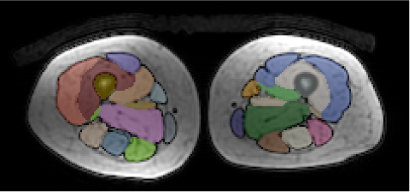
Currently, MRI appears to be a promising tool in assessing disease progression in FSHD patients. Several useful outcome measures can be derived from an MRI scan, such as muscle fat fraction; however, these require extensive segmentations of, preferably, all leg muscles. Manual segmentation of muscles is a time-consuming process that can be improved with the development of a (semi-)automatic segmentation model during the course of this project. By enabling faster and standardised analysis of MRI data, this has the potential to substantially improve disease monitoring and evaluate therapeutic interventions in FSHD. As such, the proposed internship addresses the mission of 3FM Serious Request 2025 ‘Spieren voor Spieren’ by contributing to innovative methodologies that enhance research and ultimately improve clinical care for both children and adults with neuromuscular disorders.
Description of the project:
This internship is part of two complementary clinical studies.
- FOCUS 3: A 10-year natural history study involving 170 adult and 30 pediatric genetically confirmed FSHD patients, including participants from prior FOCUS studies (FOCUS 1, FOCUS 2 and iFocus).
- MUSCLE+: An imaging biomarker study assessing the use of ultrasound-defined contractile performance as a biomarker for monitoring disease progression in patients with FSHD(n=50) and comparing this with other clinical measures, such as structural MRI
Both studies use comprehensive clinical and imaging assessments (MRI, muscle ultrasound, functional scores, etc.) to monitor disease progression and identify predictive biomarkers.
Internship goal and structure:
- Perform semi-automated segmentation of leg muscle MRI data.
- Test and compare three up-and-coming machine-learning-based muscle segmentation approaches: Dafne, QMRITools, and MuscleMap. The best approach will then be further trained and optimised by the student to segment muscles in FSHD patients, using manually-segmented data.
- A previous student has already started training Dafne models on 2-point Dixon MRI scans. Our current data consist of 6-point Dixon scans, so adaptation and further training are required to improve model performance.
- A standard operating procedure (SOP) for working with Dafne is available, based on a previous project where this model was developed. A step-by-step manual is available for this, so previous deep-learning experience is not necessary.
- Calculate and describe important segmentation metrics to evaluate model performance
- Help build a high-quality segmented MRI dataset used for e.g. fat fraction calculations and future segmentation model development.
Experience:
- Python and/or MATLAB experience
- Model optimisation
- Some knowledge of muscle anatomy preferred
Application procedure:
If you are interested, please send a short motivation letter and your CV to: Eline Boon (PhD candidate FOCUS 3) and Odette van Iersel (PhD candidate MUSCLE+)
- eline.tm.boon@radboudumc.nl
- odette.vaniersel@radboudumc.nl (daily supervisor)
- Donnie.Cameron@radboudumc.nl (head supervisor)
Please feel free to reach out with any questions regarding the content of the internship.
Example of a full muscle segmentation of both thighs in a healthy volunteer, with individual muscles having their own colour code